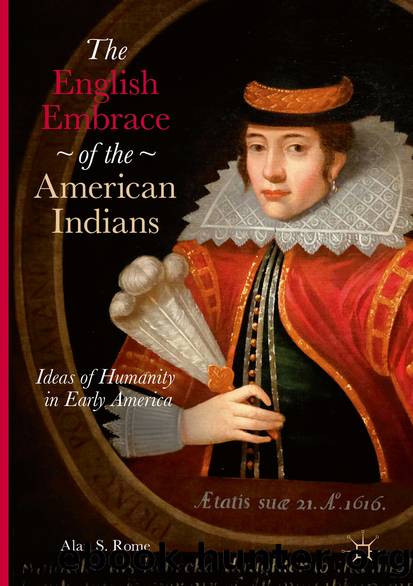
The English Embrace of the American Indians by Alan S. Rome
Author:Alan S. Rome
Language: eng
Format: epub
Publisher: Springer International Publishing, Cham
Brereton, explicitly drawing together the threads of the discussion, saw the Indiansâ health and strength as not only indications of the âholmsomnesseâ and temperate nature of the climate, but also testimonies to the health the English could look forward to if they settled there. The health of the Indians can be read as a metonym for the health of the colonists. The people and the land they inhabited embodied each other, not just metaphorically but ontologically. If the Indians were physically different from the English at all, they were superior. The climate of Virginia was perfect for human life.
*****
At the turn of the seventeenth century, English metaphysical beliefs and colonial imperatives conspired to make the Indians the same in body as the English. If health and character were partly subject to the climate, and if Virginiaâs climate was perfect for the English, then there could be no permanent difference between the coloniser and the native. While the Indians did not have the advantage of Christianity and of existing in a civil society, this difference was a simple matter of custom and history and could easily be overcome. The religious or historical understandings of worldly events trumped the natural one. The two peoples could easily become one.
Though it is easy, if unwarranted, to dismiss the arguments of colonial promoters as propaganda, these arguments were considered believable by many in the population at large. Propaganda and rhetoric, after all, are employed to convince an audience. The genre of âdescriptive geographyâ moreover enjoyed a wide vogue through the educated ranks of society, 110 and the promotional tracts were the only works in this genre available for Virginia. They thus possessed an authority that influenced other genres around them: theatre, cosmography, law, medicine. Even unaligned geographers freely adopted the arguments of the promoters, whether through genuine belief, or through the lack of alternatives and critical acumen. The geographers Abbott and Heylyn continued to believe in the division of the world into traditional climactic zones and in the environmental influence on the body, while at the same time repeating promotersâ arguments of the sameness of Virginian bodies. 111 These ideas, adopted by writer after writer and divorced from their initial context, became the common currency of wider society.
Many, both in England and across Europe, remained unconvinced by these arguments. While the colonial promoters had argued that everything was stronger and healthier in America, by the eighteenth-century colonists increasingly had to defend themselves against theorists that argued that everything, including people, degenerated in the invidious American climate. The Dutch geographer Cornelius de Pauw in 1768 argued that âNature has peopled America with children, out of whom it is impossible to make men⦠Even today, after three hundred years (since the Europeans arrived), not one of them can think[â¦]They have neither intelligence nor perfectibility.â 112 Earlier, in the 1630s and 1640s, as the English gained more experience of the Indians, and noticed the plague decimating their ranks, they began to believe that Indian bodies were inherently weaker than those of the English, and strangely less suitable to their New World clime.
Download
This site does not store any files on its server. We only index and link to content provided by other sites. Please contact the content providers to delete copyright contents if any and email us, we'll remove relevant links or contents immediately.
| Africa | Americas |
| Arctic & Antarctica | Asia |
| Australia & Oceania | Europe |
| Middle East | Russia |
| United States | World |
| Ancient Civilizations | Military |
| Historical Study & Educational Resources |
The Dawn of Everything by David Graeber & David Wengrow(1763)
The Bomber Mafia by Malcolm Gladwell(1667)
Facing the Mountain by Daniel James Brown(1600)
Tip Top by Bill James(1495)
Submerged Prehistory by Benjamin Jonathan; & Clive Bonsall & Catriona Pickard & Anders Fischer(1494)
Wandering in Strange Lands by Morgan Jerkins(1482)
Driving While Brown: Sheriff Joe Arpaio Versus the Latino Resistance by Terry Greene Sterling & Jude Joffe-Block(1410)
Red Roulette : An Insider's Story of Wealth, Power, Corruption, and Vengeance in Today's China (9781982156176) by Shum Desmond(1395)
Evil Geniuses: The Unmaking of America: A Recent History by Kurt Andersen(1393)
The Way of Fire and Ice: The Living Tradition of Norse Paganism by Ryan Smith(1371)
American Kompromat by Craig Unger(1362)
F*cking History by The Captain(1350)
It Was All a Lie by Stuart Stevens;(1343)
American Dreams by Unknown(1320)
Treasure Islands: Tax Havens and the Men who Stole the World by Nicholas Shaxson(1307)
Evil Geniuses by Kurt Andersen(1298)
White House Inc. by Dan Alexander(1244)
The First Conspiracy by Brad Meltzer & Josh Mensch(1217)
The Fifteen Biggest Lies about the Economy: And Everything Else the Right Doesn't Want You to Know about Taxes, Jobs, and Corporate America by Joshua Holland(1159)
